Posts

Showing posts with the label birds

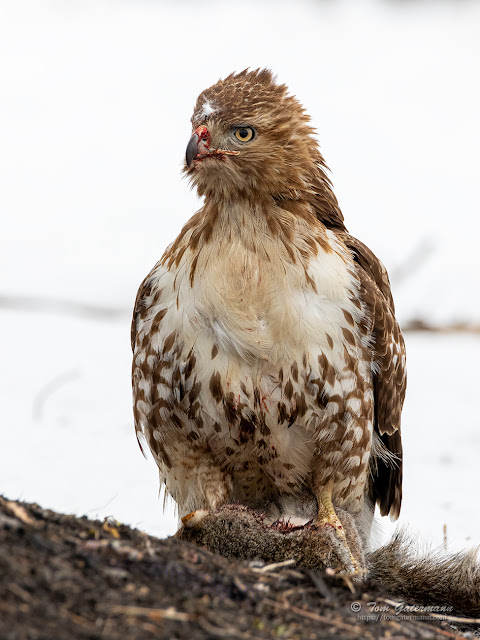
Red-tailed hawk with a fresh catch of squirrel
Image
  This red-tailed hawk stands on the ground and takes break from eating the squirrel it just caught.    Yesterday, I turned a corner in my neighborhood and spotted a red-tailed hawk tearing at and eating a squirrel it had just caught. It was on the ground about eight feet from the road. I quickly stopped a short distance from it and snapped off a few shots before it plucked the squirrel in its claws and flew away to enjoy the catch in private. Photograph taken on March 9, 2023, at Syracuse, New York.
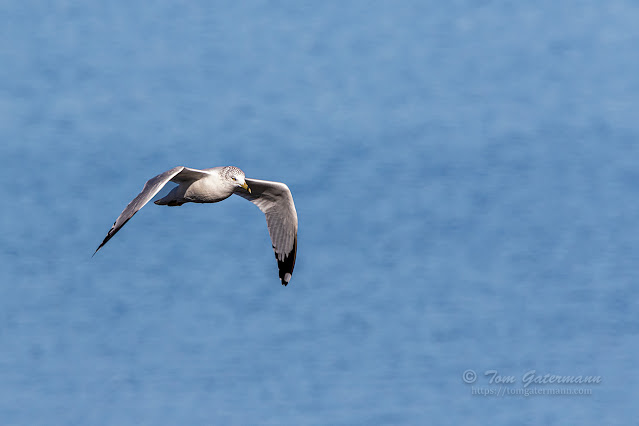
Ring billed gulls at Onondaga Lake in Syracuse, NY.

Image
On a sunny day, a nonbreeding adult ring-billed gull flies over the southern end of Onondaga Lake.  The most populous bird at Onondaga Lake has to be the ring-billed gull, commonly just referred to as a seagull.  The birds are commonly be found on coastal beaches, near inland lakes, dumps, and parking lots. While these birds can be found along the coasts they are primarily found living inland. Ring-billed gulls swooping down and trying to pluck fish from Onondaga Lake. Top photograph taken on November 9, 2022, at Syracuse, New York. Bottom photo taken on November 3, 2022, at Syracuse, New York.

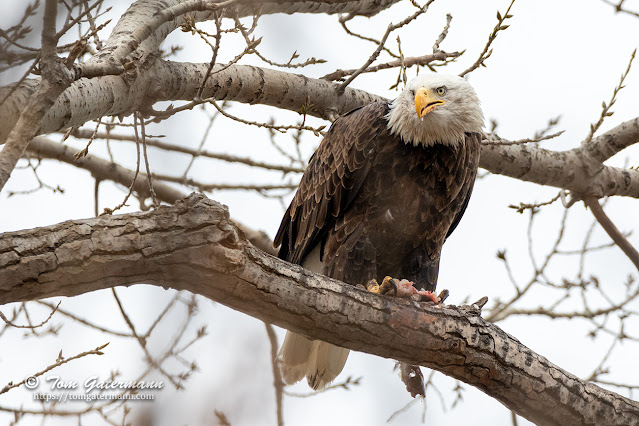
Bald eagle eating a fish on Murphy's Island at Syracuse, NY

Image
  A bald eagle is on the lookout while eating a fish at Murphy's Island.   Murphy's Island at Syracuse, New York, has become a winter-feeding ground for bald eagles in recent years. The Island is on the southeastern corner of Onondaga Lake and this part of the lake doesn't freeze over in the winter because of a nearby wastewater treatment plant. Due to the lake not freezing over by Murphy's Island bald eagles, as well as other birds, can fish the lake's waters. The bald eagle tears at the fish's remains while perched in the tree at Murphy's Island.   Murphy's Island is not an actual island. At least not that I can tell from satellite imagery of it. The "island" is surrounded by Onondaga Lake, Onondaga Creek, another creek (name is unknown), and CSX's railroad tracks . The island sits across the tracks from Destiny USA Mall. Murphy's Island can be accessed by a newly opened trail extension to the Onondaga Creekwalk trail.  While still in...

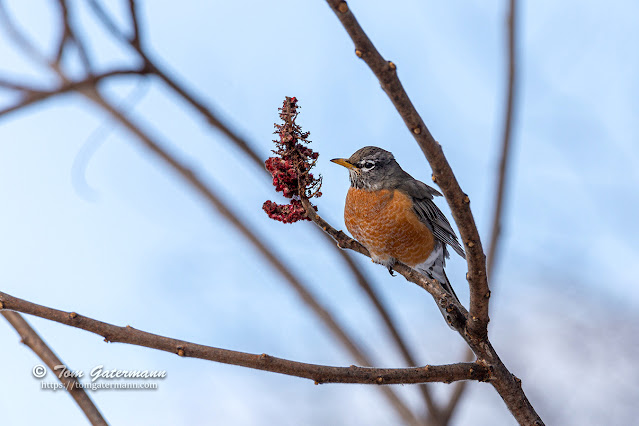
American Robin eating from a sumac seed head at Kirkville, NY.

Image
 The American Robin has become much more visible over the last month now that the spring thaw is well underway. I've seen many flitting about from tree branch to tree branch in the forest behind my house . As well as scurrying around on the lawn foraging for food. While, I haven't been able to capture a photograph of one yet near my home, I did manage to capture some photographs of a robin while over in Kirkville, New York, earlier this week. American Robin While I was in Kirkville, New York, photographing trains , I happened upon this robin perched in a nearby tree eating what looks to be a small flower or flower bud from a sumac seed head (thanks, to Jim, for his comment below identifying the sumac seed). Cornell University's All About Birds website states that in the fall and winter robins eat a lot of fruit and seeds. In the warmer months the robins forage for worms in the ground. An American Robin perched in a tree at Kirkville, NY. According to the All About Birds we...

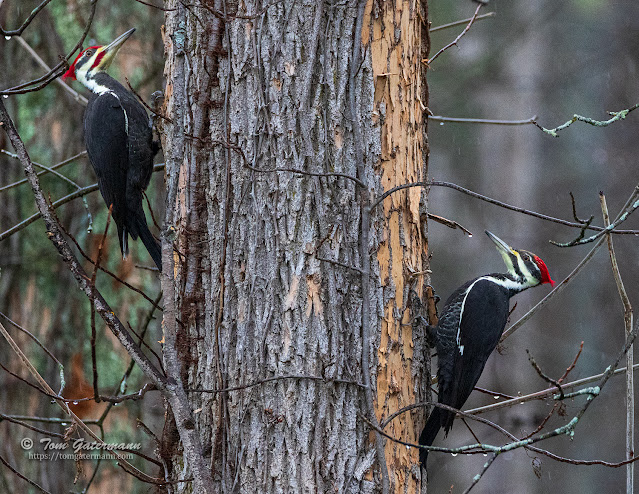
A pair of pileated woodpeckers pecking an ash tree

Image
One day last month I was sitting in my dining room helping one of my kids with schoolwork, when I happened to hear what sounded like a woodpecker pecking. I glanced out the window of the dining room and saw a pileated woodpecker couple perched on opposite sides of an ash tree at the edge of the forest behind my house.  A male (left) and female (right) pileated woodpecker pair, perched on a dying ash tree. According to Cornell University's All About Birds website , pileated woodpecker pairs stay together year-round, and are territorial, except for in the winter. During the winter they will share their territory with other woodpeckers. I've seen these two flying around at the edge of my forest but didn't realize that I was most likely seeing the same two birds each time. A female pileated woodpecker pecking on a dying ash tree. The male and female pileated woodpeckers are similar in size. The easiest way to differentiate between a male and female pileated woodpecker is the re...

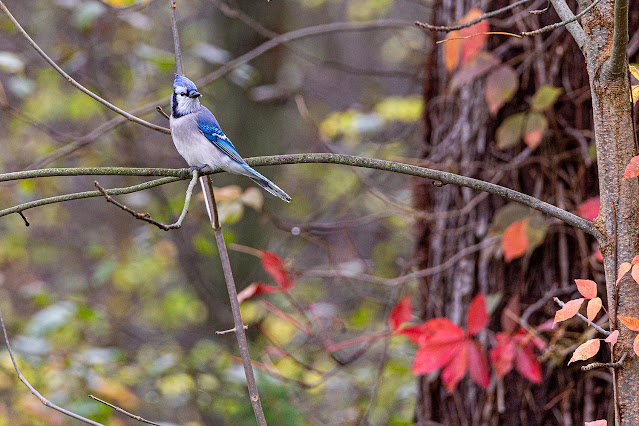
Blue Jay perched on a tree branch in my backyard

Image
Since the leaves have started falling from the trees, I've had a better view of the bird activity in the forest behind my house. The other day, I was looking out my dinning room window and I saw a blue jay flying from tree to tree. I quickly grabbed my camera and the blue jay perched itself long enough for me to snap a couple of quick photographs of it.  A blue jay sits perched on a tree branch in my backyard. In addition to this blue jay, I was able to capture photographs of a juvenile red tailed hawk  last week. Thanks to the lack of leaves on the trees, I had a clear view of the hawk. Photograph taken on October 18, 2021, near Syracuse, New York.

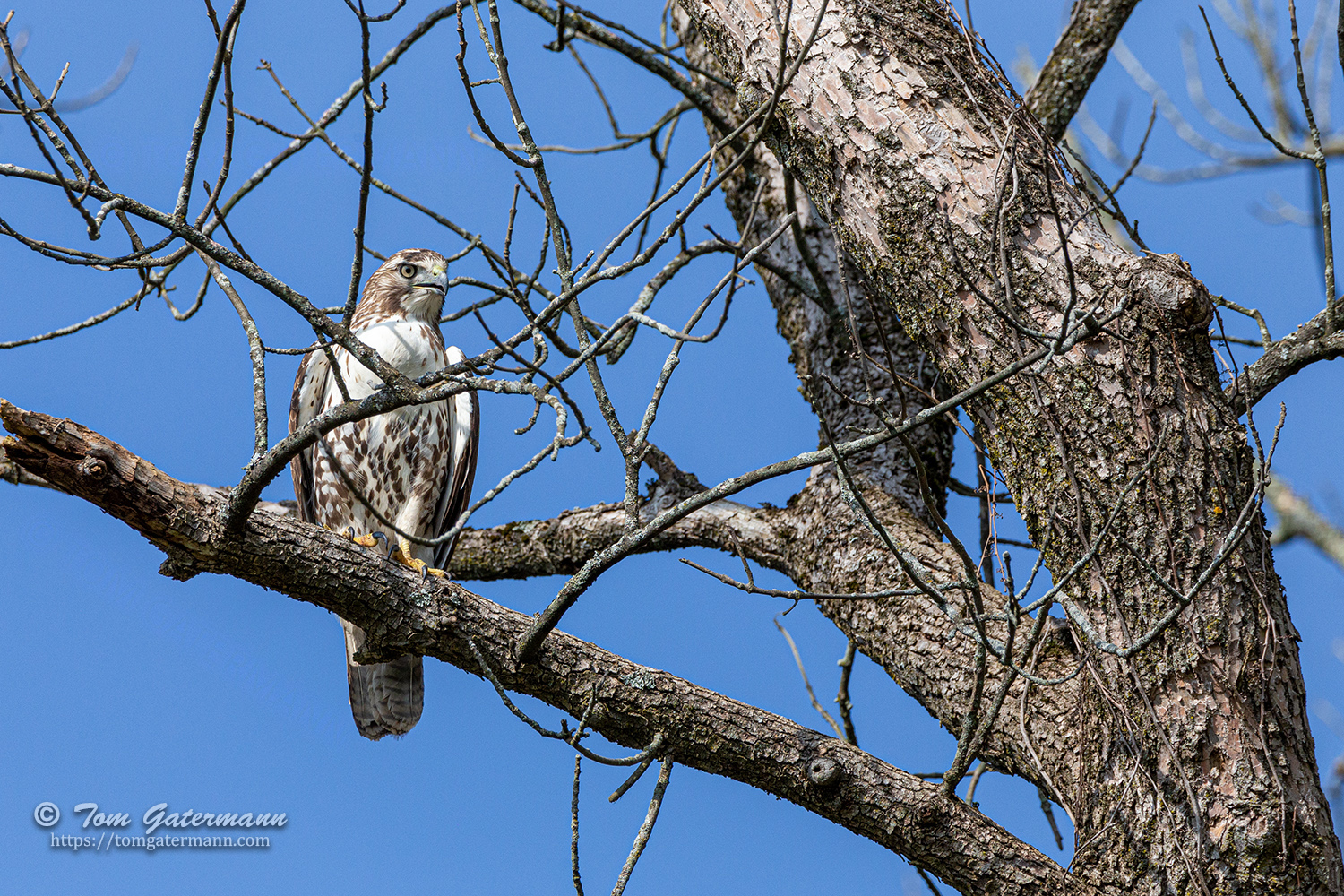
Juvenile red-tailed hawk in Central New York

Image
 While looking out of my dining room window this past week, I spotted a hawk flying above the forest behind my house . It soon quickly swooped down and landed on a branch of a dying ash tree at the forest's edge.  Juvenile red-tailed hawk After researching what type of hawk this one was on Cornell University's All About Birds website , I believe this is to be a juvenile red-tailed hawk. Juvenile red-tailed hawks don't have red tails yet, but some do have dark bands across their tails like the one seen here has. I also believe this is a red-tailed hawk due to the dark patagial marks on the front edge of its wings (you can see those better in the last photograph below), as well as its other colorations.  A juvenile red-tailed hawk perched on a tree branch. The Central New York area is at the northern edge of the red-tailed hawks year-round habitat. This time of year the red-tailed hawks that spend the warmer months further north in Canada are starting to migrate a little fu...

A turkey vulture above Oswego harbor on Lake Ontario

Image
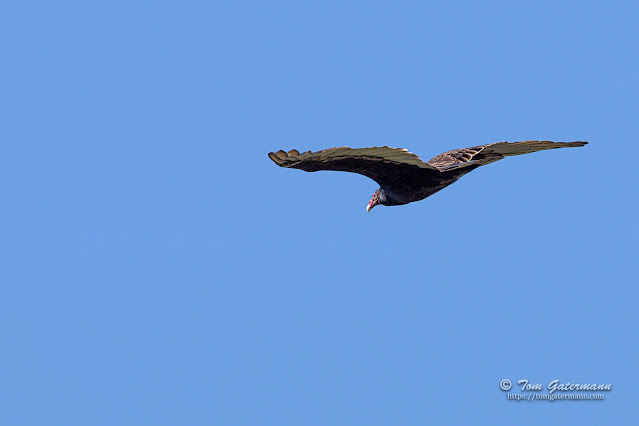
 Back in late September, we took a drive up to Oswego, New York, to see Fort Ontario and Lake Ontario. While there I tried to capture some of the birds flying above the lake. Most didn't turn out well, but I was able to get this one photograph of a turkey vulture that I was pretty happy with, even though it was from behind the bird. Soaring above the Oswego harbor on Lake Ontario. By using Cornell University's All About Birds website , I discovered that this is a turkey vulture. And, according to the Audubon Society , the area around Lake Ontario is part of the turkey vulture's breeding grounds. Turkey vultures are large birds. According to the All About Birds website, their length ranges from approximately 25-31 inches (64-81 centimeters), and their wingspans can range from 66.9-70.1 inches (170-178 centimeters). They are also carrion birds, meaning they prefer to eat dead animals.  Photograph taken on September 26, 2021, at Oswego, New York.

A male northern cardinal among the leaves

Image
 The other day I spotted this male northern cardinal wandering around my back yard, near the edge of the forest. He appeared to be looking for food, as he would peck down toward the ground every so often. Male northern cardinal I've seen quite a few northern cardinals in my yard over the last few months. The cardinals really stand out well, so they are easy to spot among the forest.  Photograph taken on October 4, 2021, near Syracuse, New York.

All images/photographs are copyrighted © by Tom Gatermann. All rights reserved. Contact me. Subscribe.